Sunday, April 8, 2012

Here's Lookin' At Casablanca, Kid

Throughout my teenage years in the seventies, I was becoming more and more the film buff savoring such film school masterpieces as BATTLESHIP POTEMKIN and RULES OF THE GAME while equally enjoying cheese such as KENTUCKY FRIED MOVIE and FIVE FINGERS OF DEATH. There were several revival houses in Cincinnati during that period and one Sunday afternoon, I saw CASABLANCA for the very first time in a crowded theater on a giant screen! It instantly became my favorite movie of all time, an honor not topped to this day.


Then, in 1983, came the second attempt at a television version. (I never saw the first one from 1955.)

It was hardly unprecedented to turn a hit motion picture into a TV series. In fact, in some cases such as M*A*S*H, the series proved to be even better than the movie! AStill, there was a considerable chorus of "What are they thinking!!??" at the time.

Once you grant that no film was so sacred that they couldn't at least try an adaptation, it's easy to see that CASBLANCA really wasn't that bad.

The major issue, which essentially doomed it from the start, was that it was impossible NOT to compare it with the original and it was heresy to even consider for a second that actor David Soul--no matter how good he might be as Rick--could be better than Bogart.

CASBLANCA even then had surpassed the point of being just a movie. It was iconic, with almost every line being quotable, every gesture memorable, every performance ingrained on film buffs throughout the world.

The series took place prior to the events of the movie with Rick still running his Cafe and shady dealings all around. David Soul, whom we had previously seen by that point in HERE COME THE BRIDES and STARSKY & HUTCH, seemed lightweight casting in the lead but carried it off reasonably well. Always reliable character actors filled other roles including Hector Elizondo as corrupt police Captain Renault and Scatman Crothers as Sam, the piano player.

The highly publicized first episode I recall being pretty good with the remaining four before the series disappeared coming off like filler. They really seemed to have nowhere to go--no vision for how to make the setting interesting. So as quickly as it came, CASABLANCA went. While the film itself continues to top "Best Film" lists, the TV series was relegated to a trivia question.


Saturday, April 7, 2012

The Jackie Gleason Show 1966-1970

One of my Father's favorite TV series was THE JACKIE GLEASON SHOW. In one form or another--including the now-classic HONEYMOONERS episodes, THE JACKIE GLEASON SHOW had been on the air since 1952, making a perhaps surprising TV star of the chubby also-ran comic and small-time character actor. I didn't pay it much attention until 1966, however, when it was reincarnated for its final time from the JACKIE GLEASON AMERICAN SCENE MAGAZINE. Before that I have vague memories of the show--mainly the Joe the Bartender sketches with Frank Fontaine-- and have seen it in reruns. It's the color episodes from Miami Beach I remember though, every Saturday night.

Jackie was known as "The Great One." He had a reputation for being able to imbibe large quantities of alcohol without getting drunk. He was known to skip every rehearsal and yet know every line perfectly. He was also a composer with many very successful albums of romantic easy listening music. He was big, loud, boisterous and not always considered to be a nice person...and yet he was one of the most beloved TV stars of them all.

For the color incarnation of THE JACKIE GLEASON SHOW, the star revived classic sketch characters like Reggie Van Gleason and The Poor Soul and brought back favorite supporting actors Frank Fontaine and Art Carney but the main attraction became the revival of THE HONEYMOONERS in what amounted ultimately to a brand new stage musical every week, often with big name guest stars of the day. Sometimes they were good, sometimes bad...but always big in the ratings.

As before, Jackie was bus driver Ralph Kramden and he lived in Brooklyn with his long-suffering wife Alice, now played not by Audrey Meadows but by musical star Sheila MacRae. His neighbor and sidekick was, as always, Ed Norton, one of the great TV characters of all time, played once again by Art Carney. Norton's wife Trixie was Alice's "partner in crime."

After finally leaving weekly television, Gleason went on to a successful film career that saw him co-starring with Burt Reynolds, Richard Pryor and Terence Hill among others. If anything, one can say that Art Carney did him one better, winning a Best Actor Oscar for the film HARRY AND TONTO and then starring in a number of theatrical and TV movies.

As far as my Dad was concerned, though, in the late sixties, Jackie Gleason was the biggest star on TV in more ways than one. That's what I grew up believing in our house and that's why I'll always remember my dad whenever I see Jackie.


Thursday, April 5, 2012

My Talk With Tony Dow


Originally Presented in Slightly Different Form at Booksteve's Library in 2011.


Premiering on CBS in 1957, LEAVE IT TO BEAVER didn’t really seem like anything special at the time. It was created by Joe Connelly and Bob Mosher who had previously written for the long-popular AMOS ‘N’ ANDY show on radio and TV and would later go on to create THE MUNSTERS. At the time that BEAVER arrived, it seemed to be just another sitcom about a family. The difference was that this one, unlike say FATHER KNOWS BEST or MAKE ROOM FOR DADDY, was told mostly from the perspective of the kids, the two brothers. As fifties comedy series go, it was also a little more realistic and even serious in its own way.

Never the huge ratings earner one might think, it was only over time and endless reruns that LEAVE IT TO BEAVER came to represent the iconic, idealized fifties suburban American family. Character actor Hugh Beaumont was perfectly cast as the stern but understanding father and Barbara Billingsley equally so as the concerned, loving mother. Theodore “Beaver” Cleaver was young Jerry Mathers (who had already worked with Hitchcock) and Tony Dow was the older son, Wally Cleaver. The series came to an end in 1963 after six seasons of gently funny episodes that have become familiar to whole new generations ever since.

As I was born in 1959, LEAVE IT TO BEAVER was probably my very first favorite sitcom and I recall watching it literally all my life. Even after it finished its original primetime run, it was on TV in the afternoons for years and then later in syndication. Today’s fans, of course, are still discovering BEAVER via DVD.

Last year, thanks to Martin Grams and in anticipation of his appearance at Martin's MID-ATLANTIC NOSTALGIA CONVENTION, I had the opportunity to speak via email with Tony Dow who played Beaver’s older but not always wiser brother, Wally.

Tony’s mother had actually been in show business many years prior to her son’s success. “My mom was one of the first stunt women in Hollywood and the ‘It’ girl, Clara Bow’s, double. She didn’t plan on a career in movies. When she was 17 or 18 years old she got a job at Mack Sennett’s studio as a ‘Mack Sennett Bathing Beauty’ which lead to minor parts in ‘Keystone Cops’ movies and stunts, etc. She met my dad when she was in her early twenties and gave up her career, if you could call it that.”

While one might think that his mother's involvement in the business had spurred his own interests in show biz, that was not really the case. In fact, Tony had been involved in swimming and diving and was associated with the Junior Olympics. “My mom,” he says, “was in her forties when I came along and long over her quick venture into the movie business.


I suppose like any mother, when the opportunity came along she was happy and proud at the chance for her son to work on TV.”

“It changed the dynamic of our family,” he continued. “She had to accompany me to the studio every day and put in what amounted to a ten or eleven hour day. It was probably tough on my dad also to have a son making money and taking his wife away. I was never aware of any issues. I had a great childhood and spent many good times with both mom and dad.”

Tony got the roll of Wally after a casting call to replace the actor who had been in the original pilot (which has recently been seen on TV Land). “The pilot for the show was made in 1956 and sold to CBS on the contingency the father and son would be re-cast. The producers had already seen 5000 or so kids and when Harry Ackerman, who signed on to be the executive producer of the show, suggested me, they called me in. He was the executive producer on another pilot I had

just completed that did not sell. I sort of rode in on the tail end of the process. Jerry and Barbara had done the pilot and were signed on. I believe Hugh was already cast and I was the last piece of the puzzle.”

I asked Tony why he decided to pursue acting rather than his diving. “It wasn’t exactly a decision to pursue one over the other,” he replied. “I continued diving for a couple of years after the show started but I had no idea the show would be as successful as it was or how time consuming it would be.” Looking back on it now with hindsight he adds that if he hadn’t won the role on LEAVE IT TO BEAVER, “I don’t think I would have gotten into the entertainment business. I was a swimmer and diver and probably would have continued on with that and knowing what I do now, I might have gone into designing or architecture or ??? Maybe coaching a sport, who knows?”


But he did get the role and as he grew into a teenager, Tony Dow found himself appearing on the covers of teen magazines and eventually Corn Flakes boxes! I asked him if he even liked Corn Flakes. “ Sure... didn’t every kid? (The) teen magazines were OK although most of the articles were pretty dumb. The cereal box was a bit embarrassing.”
After one season on CBS, the series moved to ABC.
Jerry Mathers stated in his autobiography that the move was because the sponsor was offered a better situation for the show. Tony says, “Don’t know. I was twelve or thirteen and not privy to that type of information. Because back then the shows were funded by a sponsor, in our case Remington typewriters, Ralston Purina dog food, and others, maybe they got a better deal and a better time slot at ABC.”

By the time LEAVE IT TO BEAVER ended its original nighttime run, Tony Dow was graduating high school in real life. He moved on to guest roles on other series but I asked him if he kept in touch with any of the BEAVER co-stars. “Barbara and my wife, Lauren, and I have always stayed in touch. As a matter of fact, she and I did a theater show in K.C. where she played my mom in COME BLOW YOUR HORN. Jerry and I had been touring the country doing dinner theater for a couple of years. A number of years before that, Hugh was directing a play out here where the male lead quit and he called me to fill in.”


Not long after the series ended, Tony appeared in several episodes of MR NOVAK, an early example of the kind of “relevant” TV that we saw so much of in the 1970’s. The title character was a high school teacher. On one memorable episode, students engaged in a mock UN conference as a class exercise only to have it become as controversial as the real life Cold War. “I did three episodes of MR NOVAK and I believe that was the one in which Johnny Crawford and I debated some international conflict. I always enjoyed working on the show with Jim Franciscus.” Tony played the US representative and THE RIFLEMAN’s Johnny Crawford was the Soviet ambassador. Tony went into the National Guard soon afterwards. “I was already hit with being stereotyped but always planned to continue acting, hoping to direct and/or produce sometime in the future. I continued my education in those areas.”

One of the funniest films of the seventies was KENTUCKY FRIED MOVIE and Tony’s cameo made me yell, “Hey, that’s really Wally!” in the crowded theater. Assuming they tried to get Jerry, too, I asked him what happened? “Jerry was supposed to also be in the movie but his wife at the time didn’t think he should do an X rated film. The first I heard about was when I showed up for work and John Landis told me one of the writer/producers was going to fill in. I think it was Jerry Zucker who did a great ‘Beaver.’” The same producers went on to do AIRPLANE so I guess it’s safe to assume that, with Barbara Billingsley so famously in that, they were LEAVE IT TO BEAVER fans. “I guess so. Quite a number of successful comedy writers were brought up watching the show.”

One of his most enjoyable later performances was in a fun 1983 TV movie entitled HIGH SCHOOL, USA. The movie starred Michael J. Fox but featured many nostalgic former teen stars, mostly as faculty members. Dwayne Hickman, Angela Cartwright, David Nelson, Bob Denver and Barry Livingston were just a few. LEAVE IT TO BEAVER veterans Tony Dow, Frank (Lumpy Rutherford) Bank and Ken (Eddie Haskell) Osmond all appeared. I questioned how many of these folks Tony had actually known prior to this picture. Actually, kid actors from the fifties and sixties are sort of a fraternity and we all do know each other. I can’t recall who all was in that show but I do remember having a great experience acting with Michael J. Fox whom I had met for the first time.”

As Tony mentioned earlier, he had long wanted to get into directing. I thought I had read where he started out doing commercials. “No. Although subsequently I have done a number of commercials, promos and PSA’s. Nothing anybody would remember. I studied directing and read many books on the subject. When we started THE NEW LEAVE IT TO BEAVER I was scheduled to do another HIGH SCHOOL USA and during the negotiations I was set to direct shows in the second season. That didn’t happen because Jerry also wanted to direct. Finally, I wrote a show, DRIVER’S ED, that I got to direct. I did seven or eight more episodes and when the show was over I was able to start directing on shows that were produced by people I knew."


Even as he was getting to do what he had long wanted to do, Tony Dow had been dealing with clinical depression for quite awhile before it was even diagnosed as such. “That’s the problem with depression,” he points out. “It was and is still vilified as a weakness. Eventually it became too painful to deal with on my own so I saw a Doc who gave me some insight into the illness. Back then the side effects of the medications were very unpleasant. Today’s choices are vastly improved and are saving many peoples lives.” Tony chose to become an advocate for others dealing with depression and manic depression.

“I saw and understood the issue which was still being swept under the rug. I did a couple of videos explaining my experiences and educating people about the illness and the simple solutions available. I was also able to address a Senate sub-committee on mental illness for the Institute of Mental Health... quite an experience.”


By the 1980’s, LEAVE IT TO BEAVER had been raised to its status as a classic of early television. In keeping with the trend, there was a reunion movie featuring most of the original cast. In this case, the film led to a long-running revival series called STILL THE BEAVER as well, beginning in 1983 and running for 102 episodes. I inquired if it was like going home again or if things had changed so much by then that it was all new. “Both. We had spent so many years together and more recently sharing theater experiences that everyone just fell right back into it. On the other hand, television twenty years later required different programming. Attention spans shortened and the need for more edgy material increased. Jokes, jokes and more jokes, usually unfunny, became the name of the game.”

Although happy to revisit Wally, Mr. Dow continued expanding his horizons by getting involved in doing special visual effects. As unlikely as it sounds at first, Tony Dow was in charge of those for the 1996 DOCTOR WHO TV movie featuring the sole on-screen appearance of the eighth Doctor. “The producer had a friend who was just setting up a new visual effects house and said he could do the show for $250,000. I was the effects producer and doubted he could pull it off and told the producers of my concern. We started shooting in Vancouver without an effects supervisor and the producer’s friend shortly thereafter dropped out. I had been retained in L.A. because the shots were going to be executed here. In a panic they called me up to Vancouver to revise the effects budget. I told them that as written we would need to spend $500,000+ for 150 or so shots. They only wanted to spend $250,000 so I gave them the option of doing 50 shots the standard way with producer approval at every stage or do 85 shots without any supervision other than me. They chose to do the 85 shots.”

With DOCTOR WHO, and later doing SPFX and directing BABYLON 5, gaining him even more geek cred, one might presume Tony Dow to be a sci-fi fan but that’s not the case. “Nope... very little sci-fi experience until I wrote, uncredited, and produced, it’s not my fault, movie ‘remake’ of the 50’s classic IT CAME FROM OUTER SPACE for the Sci-Fi Channel. Being involved in the visual effects made me, at the time, one of the few TV directors not bamboozled by the effects companies.

More recently, Tony’s passion has been his sculpting as seen in the video here.

“I’ve been painting and sculpting since my late teens. I had always planned to pursue sculpting seriously after I retired. I had a friend who was a successful sculptor who encouraged me to have my pieces cast in bronze, which I do frequently now.”

“I feel very proud and lucky to have been involved with such a wonderful show that affected so many lives.”

Special thanks to Tony Dow, Lauren Dow and Martin Grams. I think I’m going to go watch a LEAVE IT TO BEAVER episode now.


Wednesday, April 4, 2012

Forgotten Series of the Seventies


Originally Published at Booksteve's Library in 8/06

Today, we offer a brief look at some forgotten TV series of the 1970’s. They weren’t necessarily good…or bad for that matter, just forgotten. These are not likely to turn up in special complete series sets at Best Buy next Tuesday or any Tuesday in the foreseeable future. Even if you’re old enough, how many of these also-rans do you remember?


THE NEW ANDY GRIFFITH SHOW was created in a hurry in 1971 to get rid of the unpalatable flavor of THE HEADMASTER, the dreadful 1970 dramatic series Griffith did after abandoning Mayberry to Ken Berry. The scrambling attempt to salvage its star’s folksy image didn’t really help. Andy was cast here as the mayor (and coincidentally former sheriff) of a small Southern town, married to ever-gorgeous Lee Meriwether who had played his wife in the 1969 movie ANGEL IN MY POCKET. They were doing everything they could to make you think of the old days (I could be wrong but I seem to recall that Don Knotts was even brought in as a guest star in the first episode). Although I can’t imagine they took the time to audition kids, the two here came from somewhere and then apparently returned there when the show was quickly canceled and replaced with reruns of…THE HEADMASTER! Andy would flounder through several more attempts at series (including SALVAGE ONE and the great but stillborn ADAMS OF EAGLE LAKE) before settling in for a long and popular run as MATLOCK.


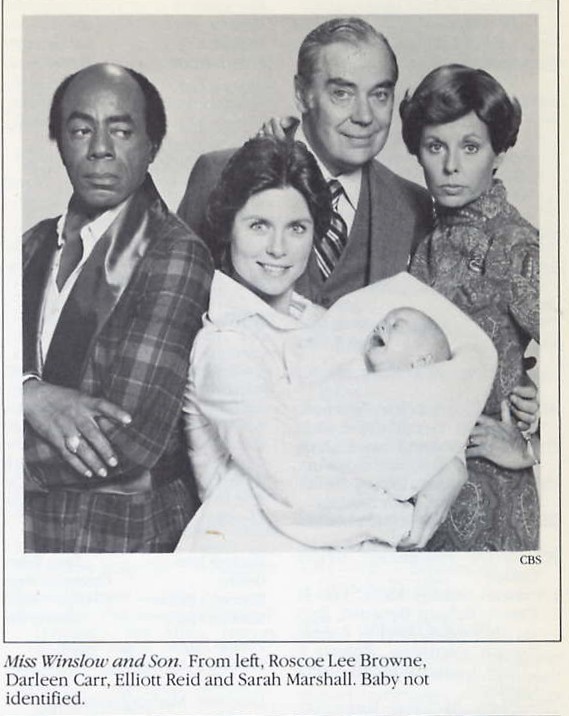
MISS WINSLOW AND SON was a controversial 1979 sitcom in which popular (and cute!) TV actress Darleen Carr played a young but unwed mother. Now you’ve got to realize just how much of a no-no this was on TV in those days. Oh, I know SOAP had already premiered and broken dozens of taboos but this sort of thing still wasn’t discussed on polite sitcoms like this one! Once you got beyond the buzzworthy concept, however, this was a fairly pedestrian comedy. Carr had grown up on TV appearing as a regular or semi-regular in many series. She was, for example, Karl Malden’s daughter on THE STREETS OF SAN FRANCISCO and Henry Fonda’s on THE SMITH FAMILY (where her brother was Ron Howard). The impressive supporting cast included radio/TV/film veteran Eliott Reid in his only regular TV role, Sarah Marshall, the daughter of actor Herbert Marshall and, rounding out the cast, the great Roscoe Lee Browne. Browne would soon replace Benson on SOAP when television showed that it still preferred not to have nice girls doing this sort of thing and cancelled the series quickly.


SWISS FAMILY ROBINSON was produced in 1975 by Irwin Allen, here going back to the source material that had previously led him to do LOST IN SPACE. TV vet Marty Milner starred with a professional cast that included Cameron Mitchell (who had just about the most varied career of any actor ever!) and Pat Delany. Even the kids were veterans. Willie Aames went on, of course, to fame and later infamy on EIGHT IS ENOUGH and CHARLES IN CHARGE before getting his act together and creating BIBLEMAN. Most recently, he appeared on the voyeuristically entertaining CELEBRITY FIT CLUB. The real star here, though, is Helen Hunt who, instead of posing for PLAYBOY or knocking over liquor stores like many former child stars went on to win Oscars and Emmys! A well produced and enjoyable family show, the series lasted only one season
.
 There were lots of forgotten series in the seventies! Pictures today came from Vincent Terrace’s TELEVISION 1970-1980.

Tuesday, April 3, 2012

Here Come The Brides


It’s a Sunday afternoon in the Fall of 1968. I’m 9 years old and I’m visiting my friend Timmy for the first time at his new house. We’re getting ready to run outside and play and he goes upstairs to get something. He’s gone quite a while. The television had been left on in the living room downstairs where I was and the first episode of a new series came on—HERE COME THE BRIDES. I had heard about this new show but didn’t really think it looked all that good—sort of a TV version of the movie musical SEVEN BRIDES FOR SEVEN BROTHERS, which my Mom loved but I couldn’t stand. By the time Timmy came down, though, I was hooked in by the catchy theme song, SEATTLE, and we had to wait until the episode ended before we ran around outside.
 
The reason that HERE COME THE BRIDES was on Sunday afternoon was that the local ABC affiliate had a habit then of displacing programs to the weekend so they could air local shows in prime time.

HERE COME THE BRIDES is the story of three Seattle brothers in the 1860’s who travel to the East Coast by ship to bring back 100 marriageable women for the loggers in the town. Underlying the trip is a high-stakes bet between logger Jason Bolt and sawmill owner Aaron Stempel as to whether the year-long experiment will succeed.

Jason Bolt, played by actor Robert Brown, is portrayed as the stereotypical hero. He’s tall, handsome, stalwart, broad-shouldered and with a million dollar smile. He always wears his trademark leather outfit. Eye candy for the ladies for sure.
But the eye candy didn’t stop there. Jason’s two younger brothers, Joshua and Jeremy, were portrayed by future Hutch (as in STARSKY AND…) David Soul and soon-to-be America’s # 1 pop recording sensation, Bobby Sherman. Although the younger of the two, Sherman had already had some success as the house singer on SHINDIG a few years earlier.

For the guys, there was just plain Candy—Bridget Hanley, a lovely young actress whose trademark on the show was her old-fashioned hairstyle.
 
Rounding out the cast of the series were-- the great Joan Blondell, one of the best wisecracking dames in the history of movies, here filled out a bit but still gorgeous a saloon owner Lottie who takes the girls under her wing; Henry Beckman, an actor known before and after for his solid but bland performances, here allowed to chew the scenery with great aplomb as Captain Clancy; Mark Lenard, forever best known as Spock’s Vulcan father Sarek in the various TV and film versions of STAR TREK, as Aaron; Susan Tolsky as what passes fro Candy’s goofy neighbor, Bo Svenson in early episodes as “Big Swede” and, in the second and final season, Candy’s young niece and nephew, Molly and Christopher. 

Early on, there was a vague serial aspect to the series, itself a Western but generally without any of the traditional staples of a TV Western. Plots dealt with the courtships of various characters, the unhappiness of the women, local disasters and the family interplay with the Bolt Brothers. Famously, Bruce lee even appeared as a guest star in one episode dealing wit the Chinese community in the American West.

Josh was the impetuous one, Jeremy the stammering dreamer, Jason the altruistic self-styled leader of the town. Even though he was 42 when the series started, one would be hard-pressed to find an actor at that time that more defined the word “swashbuckler” than Robert Brown. Along with Soul and Sherman, he, too, became a teen idol. 


Bobby Sherman parlayed the gig into a series of hit singles and albums and concerts filled with screaming teenyboppers. With his fluffy hair, love beads and peace signs, his shirtless photos adorned countless issues of SIXTEEN, FLIP and TIGER BEAT. After the series had run its course, those mag spots were taken over by THE PARTRIDGE FAMILY’s David Cassidy and Bobby quickly and sadly became a bit of a trivia question.

The series only ran two seasons but its fans have been fiercely loyal. One of those fans was apparently writer Barbara Hambly who wrote a STAR TREK novel that was actually an unauthorized HERE COME THE BRIDES novel in which Spock ended up in nineteenth century Seattle under the wing of Aaron Stempel---whom you’ll recall was played on TV by the actor known for playing Spock’s father!

More recently a more proper book was written about the series and came out from Bear Manor Media. There’s talk of remaking it as a feature film for 2013.

Robert Brown went on to a syndicated underwater adventure series entitled PRIMUS. David Soul blazed through STSARSKY & HUTCH and later played the Bogart role in the ill-advised TV remake of CASBLANCA. Still later, he starred in the title role in JERRY SPRINGER, THE OPERA. Bobby Sherman had another short-lived series, GETTING TOGETHER, but soon retired to become an emergency responder, only recently returning to oldies concerts in the 21st Century.

Meanwhile, back in 1968, I found out later that night that my fifth grade girlfriend Debbie had caught the show, too. She immediately developed a crush on Bobby and I had to hear about him a lot. I started buying his records, wearing fringed vests and love beads and growing my hair longer.  


Monday, April 2, 2012

One Day At a Time

In 1975, I was sixteen years old and worried about what every other sixteen year old worried about--acceptance, rejection, growing up and sex.

In the early year of the seventies, television sitcoms had become divided into two basic types: Filmed sitcoms with or without an audience (THE BOB NEWHART SHOW) or taped sitcoms with an audience (ALL IN THE FAMILY). Both types tended to deal with more adult themes than the sitcoms of a decade earlier but none really touched on the things that concerned me personally...until ONE DAY AT A TIME.

ONE DAY AT A TIME was a taped sitcom which gave it a stage-y feel as people often had to hold their lines for laughter or applause. The basic premise was that you had newly divorced Ann Romano who moved to a new city with her two teenage daughters and was attempting to raise them alone. Well...alone with the help of "Uncle David," Mom's divorce lawyer who openly worshiped her and Schneider, the buffoonish but somewhat creepy building superintendent.

The oldest daughter was Julie, played by Mackenzie Phillips, daughter of John Phillips of The Mamas and Papas. The younger daughter, Barbara, was played by newcomer Valerie Bertinelli. Mom was Bonnie Franklin, one of those character actresses one spots in a dozen old movies and shows from the sixties. Richard Masur was David and old pro Pat Harrington, Jr was Schneider.

ALL IN THE FAMILY's Norman Lear produced the series. Created by actress Whitney Blake (HAZEL) and ostensibly based on her own life raising daughter Meredith Baxter (FAMILY TIES), ONE DAY AT A TIME would eventually be forced by circumstances to veer far afield from its original premise.

In the beginning, week after week, the episode plotlines alternated between those of the mother and the daughters but more often than not touched on the girls worrying about acceptance, rejection, growing up and sex--just like me!

Needless to say, I could relate. It was for a while my favorite series! My favorite character was the David character, the most realistic in my opinion. So, of course, he's the one written out early on. The rest of the cast become more and more dysfunctional as time goes on, partly due to behind-the-scenes issues, the biggest of which was Mackenzie's drug use. At one point she was actually fired from the show. She managed to get herself cleaned up and then came back only to leave again for the same problem.

Over the course of the series 9 seasons, we dealt with drugs on camera as well. Also, losing one's virginity, pregnancy, spousal abuse, child abuse, drinking, death, stealing and any other "issues" one might think of. In fact, ONE DAY AT A TIME became an "Issue of the Week" show, often veering into pathos, bathos and overwrought dramady.

Franklin's portrayal of Ann Romano took risks, making her a strict and stern feminist mother who was often shrill and unsympathetic to viewers. Julie, too, with her on-the-air and off-the-air antics, became not only physically wasted over the seasons but a fairly terrible character at times, too. In the course of the series, she marries Max, played by Michael Lembeck (son of Harvey Lembeck who played on THE PHIL SILVERS SHOW) and has a baby. Barbra also marries and the girls and their spouses at one point move in together. Meanwhile, Ann starts a business but her business partner dies and she raises his son (played by Glenn Scarpelli whose real-life dad worked for Archie Comics), then she herself marries Barbara's husband's father (played by WKRP's Howard Hesseman). As you can see, it became a soap opera with the occasional laughs.

A number of interesting actors who appeared multiple times over the nine year run were Jim Hutton, Nanette Fabray, Shelly Fabares, Elinor Donahue, Boyd Gaines (who went on to be a Broadway actor and an audio book reader of some renown), John Hillerman and two folks I myself would meet online many years later, Derrel Maury and the late Kip King.

The only character who stayed constant throughout the entire run was Harrington's lecherous handyman, Schneider, and even then he was softened tremendously by the end. The final episode only features Schneider, in fact, and served as a pilot to a spin-off that never came to be.

Looking back, the videotaped "adult" comedy-dramas of the seventies really have NOT aged well at all. The writing that once seemed so edgy now seems heavy-handed and the stagey performances can be grating rather than involving.

I had kind of a crush on Mackenzie Phillips when ONE DAY AT A TIME started, having seen her before in a TV film entitled MILES TO GO BEFORE I SLEEP and in the theatrical release, RAFFERTY AND THE GOLD DUST TWINS starring Alan Arkin. Mackenzie has had more ups and downs ever since being fired from the show the last time. She's still here, though, and recently published a startling and controversial autobiography.

Valerie Bertinelli famously married lookalike rock star Eddie Van Halen but they divorced after many years together that produced Wolfie Van Halen! In recent years, she has been touting Jenny Craig programs.

Bonnie Franklin's appearances since the show ended its long run have been mostly onstage.

In 2005, all four of the show's main stars reunited for a reunion special clipfest.

ONE DAY AT A TIME hasn't aged well but maybe it wasn't meant to. At the time when I needed to know that some of the issues I had were universal, Barbara and Julie were there for me...and I'll always have fond memories of the way things were then.

Sunday, April 1, 2012

Skipper, Larry and Uncle Al

A SLIGHTLY DIFFERENT VERSION OF THIS POST WAS ORIGINALLY POSTED AT BOOKSTEVE'S LIBRARY IN 2006. 

Someday, I think someone will write a definitive history of Bozo the Clown, one of my all-time favorite kids show hosts. Author Tim Hollis comes close with his HI THERE, BOYS AND GIRLS! but only if you read between the lines and leave out the hundreds of other kids show hosts covered in the book.

Bozo may have been omnipresently franchised throughout the country but they’re all here from the famous (Soupy Sales) to the infamous (Ghoulardi) to the obscure (Cincinnati’s own "Mr. Hop," a guy in a giant bunny suit that I totally and completely blocked from my adult mind despite it having been a personal favorite at age two!!). In fact, it seems as though every major US city had a popular local kids show host from the fifties through at least the mid-sixties and Hollis really does chronicle them all.

My first thought was that reading about my own local celebs would be a bit nostalgic but that reading about the kids shows in, say, Rapid City, Iowa would be boring and pointless as I had no frame of reference. Not so. The author’s introduction sets up the climate in which these shows flourished and looks at the bigger picture. Thus when you read each segment, it’s like looking at pieces of the bigger puzzle that you just hadn’t seen before.

My own childhood heroes are well represented although Hollis describes Skipper Ryle as "surly." I guess I can see it but I never thought of him that way. His daily show was playful and imaginative with puppets and cartoons and contests even if the whole "Skipper" idea had already been pushed to the background by the time I got to it i the early sixties. His longer Sunday show was a bit more adult and featured guests, music and AMERICAN BANDSTAND style dance segments (usually set to Tommy Roe, Herman’s Hermits or Ron Dante’s Cuff Links music).

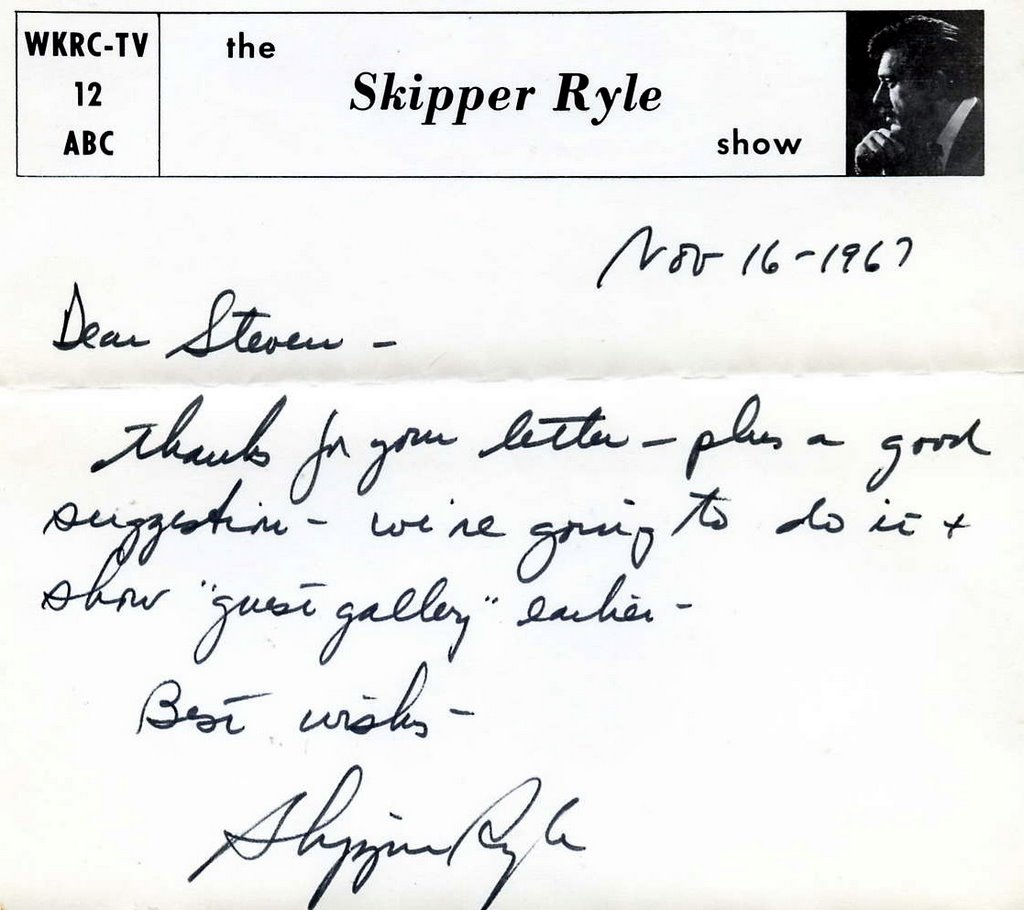
The first prize I ever won was a pizza coupon from Skipper Ryle in 1965 and my art appeared on TV in his art gallery segment in '67! Oddly enough, I missed it because I had to go to school so I wrote in suggesting they run that segment earlier. He wrote back personally and said they would…and they did!

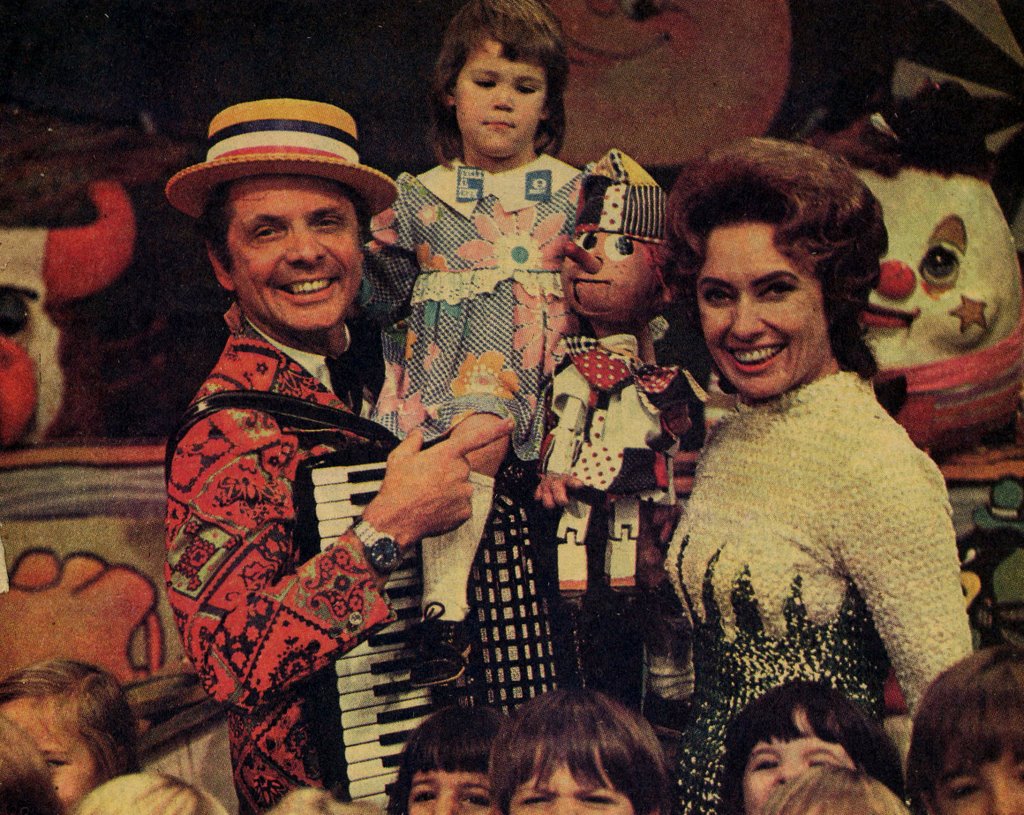
Grown adults will tell you that Cincy’s Uncle Al was "mean" and "no fun." Hey, imagine how you’d feel after carrying a huge accordian around for thirty years in a studio full of screaming kids all day! I never got to be on Uncle Al’s show but I watched it off and on for more than two decades and even as an adult found the man’s image at least to be absolutely charming.

I got to see Skipper Ryle, Uncle Al (with his wife, the lovely Captain Windy, and their four daughters!) and the great Larry Smith and his puppets live at Coney Island in 1971 just before that venerable institution closed to make room for Kings Island. Uncle Al continued for years and Larry’s show faded but with occasional revivals as late as the late 1990’s. For awhile, Larry shopped at the bookstore I managed. A few years back I got to meet Larry AND his puppets during a signing for a book on Cincinnati Television. Uncle Al and Captain Windy were expected but got snowed in. Skipper had long since passed by that point.

Skipper Ryle, using his real name, Glenn, but still referred to by most as "Skipper," later went on to become the host of the afternoon movie, the host of BOWLING FOR DOLLARS, the sidekick on THE NICK CLOONEY SHOW and, eventually, weatherman on Nick’s award-winning news team in the seventies.

Tim Hollis illustrated his book with scores of rare character poses but somehow missed any shots of Skipper Ryle so, other than his cover, I’ve chosen to illustrate my piece with some scenes from local TV mag covers featuring Glenn Ryle, Uncle Al and Larry Smith’s Puppets.